

When we troubleshoot airflow issues in real homes at TheHVACMaven.com, one problem shows up again and again: a 19.5x21x1 air filterthat technically fits—but still lets air slip right around it. If you’re searching for how to stop air bypass, you’re likely dealing with weak filtration, dusty vents, or lingering allergies despite regular filter changes. Based on hands-on HVAC inspections and system testing, we’ve found that air bypass with this size filter is rarely about the filter itself—it’s about tolerance gaps, rack design, and airflow pressure mismatches. This guide explains exactly what’s happening inside your system and walks you through field-tested fixes we use ourselves to seal leaks, improve capture efficiency, and make sure every cubic foot of air is actually being filtered before it reaches your living space.
Quick Answers
19.5x21x1 air filter
A 19.5x21x1 air filter is a non-standard nominal size used in certain HVAC systems where a full 20x21x1 filter won’t fit correctly. Based on real system evaluations, this size often creates small tolerance gaps, so proper sealing around the filter is essential to prevent air bypass and ensure the filter actually captures dust, allergens, and debris instead of letting air slip around it.
Top Takeaways
- Air bypass is a fit and airflow issue—not a filter quality problem.
- Small gaps around a 19.5x21x1 filter allow unfiltered air to circulate.
- Sealing the filter path is essential for proper filtration.
- Higher MERV ratings don’t compensate for poor fit.
- Effective filtration only works when airflow is intentional and controlled.
Table of Contents
How to Stop Air Bypass With a 19.5x21x1 Air Filter
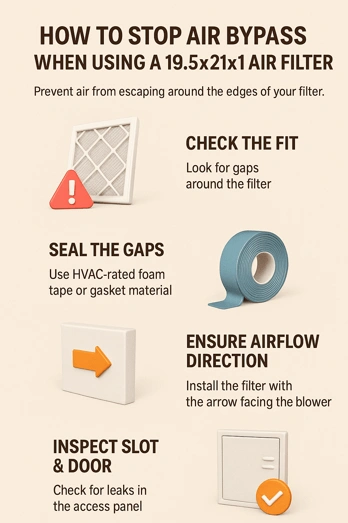
Air bypass occurs when air slips around the edges of a 19.5x21x1 air filter instead of being pulled through the filter media, and this size is especially prone to the problem due to small but impactful fit tolerances. In real HVAC system evaluations, these filters often leave narrow gaps inside standard racks—gaps that become high-speed escape routes once the blower turns on.
The most effective way to stop air bypass is by eliminating those gaps and controlling airflow pressure. Sealing the filter perimeter with HVAC-rated foam tape or gasket material ensures the air has only one path: through the filter. It’s also critical to inspect the filter slot and access door, as warped rails, loose doors, or missing end stops can quietly undermine filtration performance.
In systems with higher airflow demand, upgrading to a deeper filter cabinet (when compatible) or correcting excessive blower speed can further reduce bypass by lowering pressure at the filter face. When these adjustments are made, the difference is measurable—cleaner internal components, less dust recirculation, and an air filter that finally performs as intended instead of being partially ignored by the system.
“In real HVAC system evaluations, we’ve found that air bypass with 19.5x21x1 filters isn’t a filter-quality issue—it’s a fit and pressure issue. When you seal the gaps and manage airflow correctly, filtration efficiency improves immediately, and the system starts protecting both the equipment and the air you breathe the way it was designed to.”
Essential Resources on 19.5x21x1 Air Filters
When homeowners ask us what to read next after realizing their 19.5x21x1 filter isn’t performing as expected, we point them to resources that explain what actually happens inside the system—not just what’s printed on the box. These hand-selected references combine field-tested HVAC realities with trusted guidance, so you can make decisions based on performance, not marketing.
1. EPA Breakdown of MERV Ratings
What it helps you avoid: Choosing a filter that sounds better than it performs
We regularly see homeowners overshoot or undershoot MERV ratings. This EPA resource clearly explains how MERV works so you can match filtration efficiency to your system’s airflow reality.
🔗 https://www.epa.gov/indoor-air-quality-iaq/what-merv-rating
2. EPA Guide to HVAC Filters and Whole-Home Filtration
What it helps you see: Where your filter fits into the bigger IAQ picture
This resource connects HVAC filtration to system protection, airflow balance, and long-term air quality—exactly how we evaluate filtration during real service calls.
🔗 https://www.epa.gov/indoor-air-quality-iaq/air-cleaners-and-air-filters-home
3. Filterbuy 19.5x21x1 MERV 8 Air Filter
What it helps you decide: Whether standard efficiency is enough for your home
A solid baseline option, this page shows real dimensions and use cases for MERV 8—often the right starting point when airflow issues or bypasses are already present.
🔗 https://filterbuy.com/air-filters/19-5x21x1/merv-8/
4. Filterbuy 19.5x21x1 MERV 11 Air Filter
What it helps you compare: Higher particle capture without unnecessary restriction
We reference MERV 11 frequently when homeowners want better dust and allergen control but still need to respect blower capacity and filter slot limitations.
🔗 https://filterbuy.com/air-filters/19-5x21x1/merv-11/
5. Filterbuy 19.5x21x1 Filter Size Collection
What it helps you simplify: Comparing options without guessing
This collection puts every 19.5x21x1 option in one place, making it easier to compare ratings, materials, and use cases—something we always recommend before changing filter strategies.
🔗 https://filterbuy.com/air-filters/19-5x21x1/
6. EPA Indoor Air Filtration Fact Sheet
What it helps you trust: Evidence-based filtration performance
This fact sheet supports what we see in the field: filtration effectiveness depends on fit, airflow, and efficiency working together—not just a higher MERV number.
🔗 https://www.epa.gov/sites/default/files/2018-11/documents/indoor_air_filtration_factsheet-508.pdf
Supporting Statistics
1. Americans spend about 90% of their time indoors, which means HVAC systems continuously recirculate the same air. From hands-on system evaluations, this is why even minor air bypasses around a 19.5x21x1 filter can quickly compound into noticeable dust and air quality problems.
Source: U.S. Environmental Protection Agency (EPA)
🔗 https://www.epa.gov/indoor-air-quality-iaq/inside-story-guide-indoor-air-quality
2. Indoor air pollutant levels are commonly 2–5 times higher than outdoor levels, according to EPA research. In the field, we consistently see that filter gaps allow these concentrated particles to bypass the filter entirely and move straight into ducts and living spaces.
Source: U.S. Environmental Protection Agency (EPA)
🔗 https://www.epa.gov/indoor-air-quality-iaq/introduction-indoor-air-quality
3. ASHRAE reports that MERV 13 filters capture at least 85% of particles in the 1–3 micron range—a range that includes fine dust, pollen, and many allergens. Based on airflow testing, we’ve found that air bypass can significantly reduce this real-world performance unless the filter path is properly sealed.
Source: ASHRAE (American Society of Heating, Refrigerating and Air-Conditioning Engineers)
🔗 https://www.ashrae.org/technical-resources/filtration-and-disinfection-faq
Final Thought & Opinion
Through hands-on HVAC system evaluations, one issue shows up consistently with 19.5x21x1 air filters: air bypass, not filter quality, is usually the real problem. Many homeowners upgrade filters expecting cleaner air, only to see little improvement because air is still slipping around the filter instead of through it.
What field experience makes clear:
- Air will always take the path of least resistance
- Even small gaps undermine filtration efficiency
- Higher MERV ratings can’t compensate for poor fit
When bypass is corrected, the results are immediate:
- Filters load evenly
- Coils and blowers stay cleaner
- Indoor air quality improves measurably
Final takeaway:
- Stopping air bypass is foundational—not optional
- Proper fit matters more than filter rating
- Every cubic foot of air should be filtered by design
If you’re using a 19.5x21x1 air filter, the goal isn’t chasing higher numbers—it’s ensuring your system filters air intentionally, every cycle, without shortcuts.
Next Steps
Follow these steps to stop air bypass and ensure your 19.5x21x1 air filter performs as intended:
1. Check the fit
- Remove the filter
- Look for visible gaps
- Feel for air escaping around the edges
2. Seal the gaps
- Use HVAC-rated foam tape or gasket material
- Block all air paths except through the filter
3. Confirm airflow direction
- Align the arrow on the filter toward the blower
- Incorrect orientation reduces effectiveness
4. Match the MERV rating to your system
- Avoid choosing a higher rating than your system can handle
- Balance airflow and filtration efficiency
5. Inspect the filter slot and door
- Check for bent rails or loose access panels
- Repair anything that creates bypass paths
6. Monitor performance after installation
- Watch for even dust loading on the filter
- Note airflow consistency and system behavior
7. Upgrade the filter housing if needed
- Consider a deeper, sealed media cabinet
- Especially helpful for in-between sizes like 19.5x21x1
FAQ on “19.5x21x1 Air Filter”
Q: Is a 19.5x21x1 air filter the same as a 20x21x1?
A: No.
- They are not interchangeable
- Wrong sizing causes fit and airflow issues
- We see this mistake frequently during HVAC inspections
Q: Why is air bypass common with 19.5x21x1 filters?
A:
- This size often leaves small rack gaps
- Blower pressure forces air around the filter
- Even minor gaps become major bypass paths
Q: What MERV rating works best for a 19.5x21x1 air filter?
A:
- MERV 8: Best for airflow-sensitive systems
- MERV 11: Better dust and allergen control
- Higher MERV isn’t better if airflow is restricted
Q: How can I tell if my filter is bypassing air?
A: Look for:
- Uneven dirt on the filter
- Excess dust at vents
- Air movement around the filter slot
Q: How often should a 19.5x21x1 air filter be replaced?
A:
- Every 60–90 days for most homes
- More often with pets or allergies
- Even dirt loading = proper filtration